


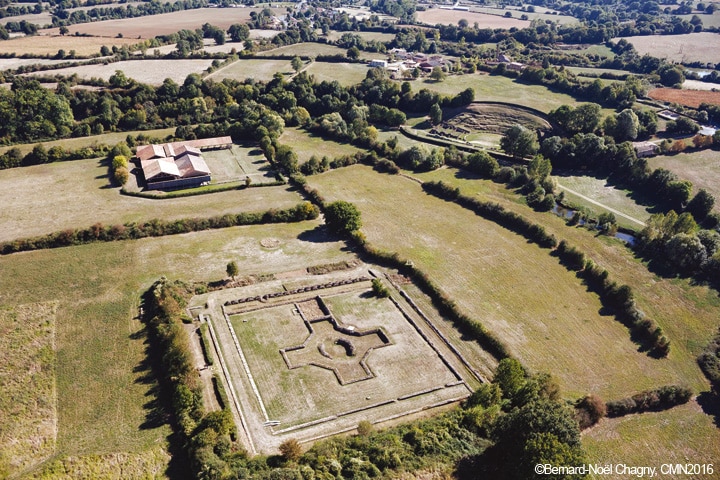
The archaeological site of Sanxay was one of the major Gallo-Roman towns in the ancient province of Aquitaine, inhabited from the 1st to the 4th century AD.
A vast ancient site, now preserved and protected
This site, covering an estimated area of 25 hectares, was a thriving town occupied from the 1st to the 4th century, featuring houses, shops, a theatre, thermal baths and a sanctuary. Its distinctive feature is that it is crossed by a river, the Vonne.
Abandoned from the 4th century onwards, the site was subsequently used as a stone quarry.
It was not until the late 19th century that it was excavated by Father Camille de la Croix, a pioneer of archaeology, and his team.
In 1881, having learnt of the existence of a vast deposit of Gallo-Roman ruins, he began work on the site with around fifteen labourers. He financed a major campaign to clear the remains using his own money.
For almost three years, these large-scale excavations – carried out from February 1881 to October 1883 – covered around fifteen hectares out of a total of twenty-five and brought to light the main public monuments: the theatre, the thermal baths and the sanctuary.
They also revealed a densely populated, bustling city, comprising streets, houses (domus) and even an aqueduct, which has since been backfilled.
During this period, Jean-Camille Formigé, chief architect of historic monuments, produced numerous watercolour drawings of the ancient buildings.
At the end of the excavations, Father Camille de La Croix requested that the site be purchased and preserved by the State, which was partially achieved on 24 July 1884 with the acquisition of the plots comprising the theatre, the thermal baths and the sanctuary.
His documents, notebooks, plans, drawings and photographs are preserved and available for consultation at the Vienne Departmental Archives.
Many archival documents have been digitised in collaboration with the University of Poitiers and are available on their website: the Father Camille de La Croix Collection.
All the artefacts discovered on the site during the excavations are held at the Sainte-Croix Museum in Poitiers.
After being listed as a historic monument in 1882, the Gallo-Roman site at Sanxay was purchased by the State in 1884. The acquisition of further plots in 1995 means that the site is now a 15-hectare archaeological reserve.
Theatre, thermal baths and sanctuary…
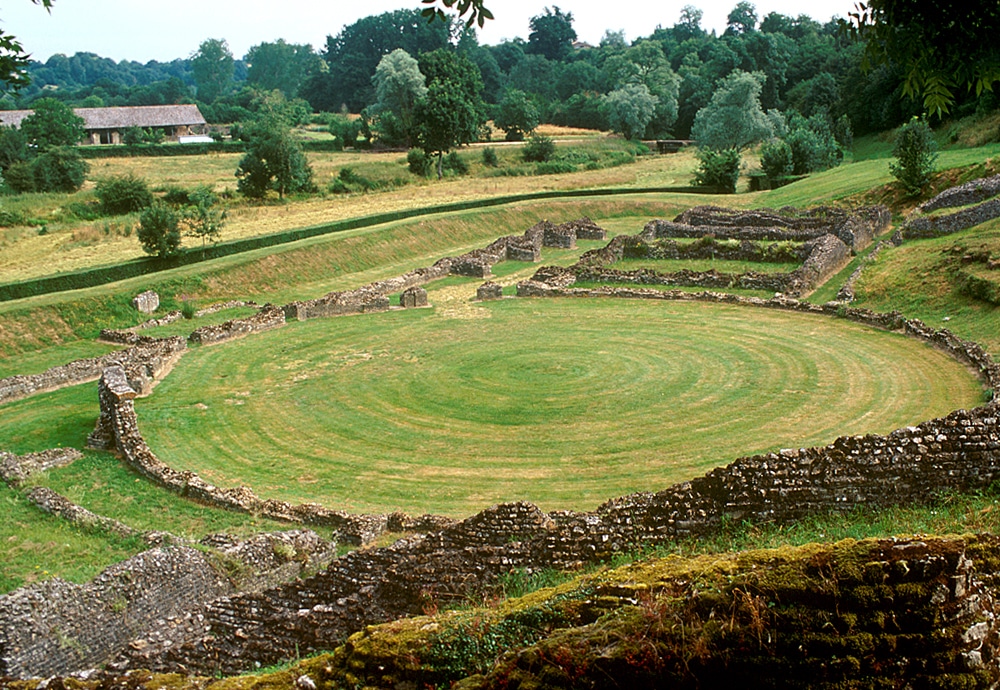
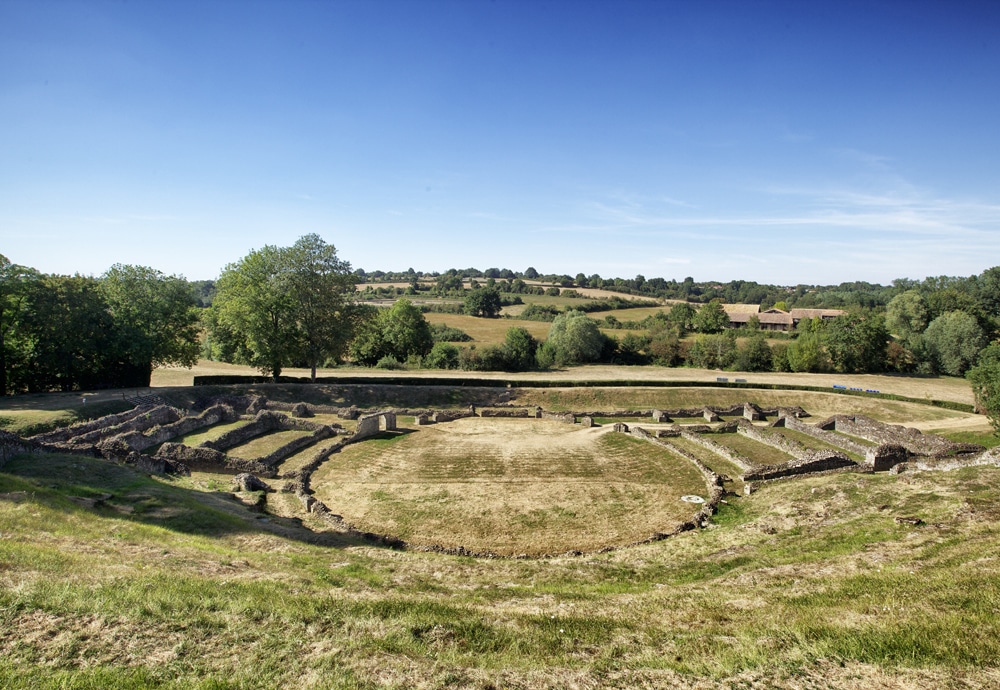
The theatre’s hybrid architecture, blending the form of a classical theatre with that of an amphitheatre, suggests a wide variety of events. It may have hosted various kinds of games, plays or combat displays.
The Sanxay theatre could accommodate around 6,500 spectators. That’s as many as the Zénith in Paris!
Boasting exceptional acoustics, this venue has been hosting open-air operas for the past twenty years or so as part of the Sanxay Opera Evenings in August.
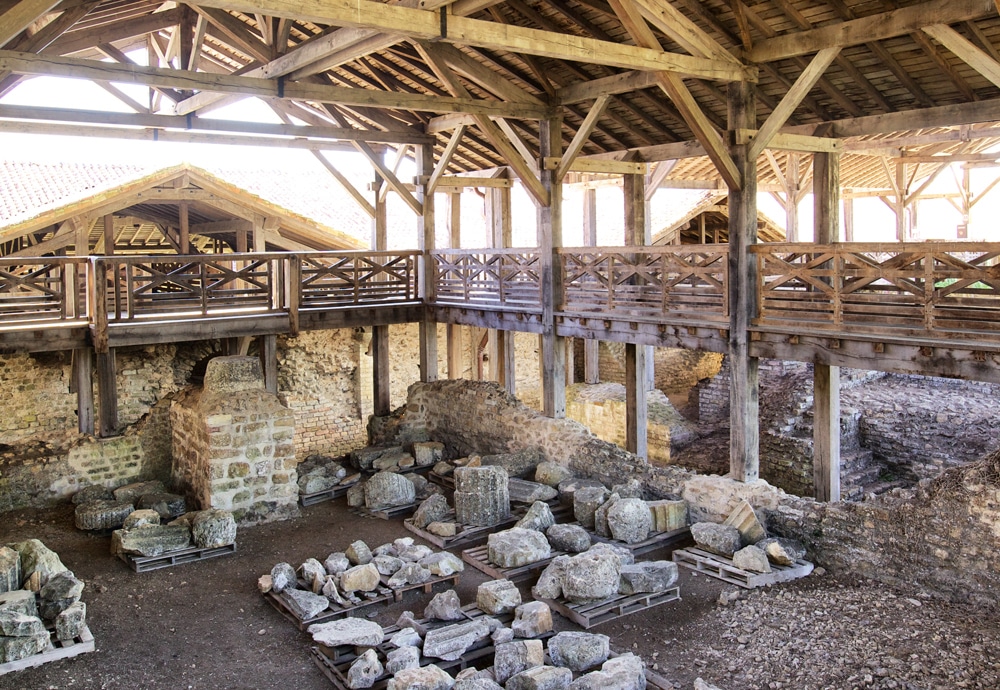
The thermal baths are protected by a roof and are in an excellent state of preservation.
The current ground floor was in fact level -2. This is the technical area dedicated to the maintenance of the fireplaces used to heat the pools and to the drainage of waste water.
Above this, Level -1 is occupied by the pools reserved for bathers. After passing successively through the three main heated pools, they completed their circuit by plunging into a large, unheated open-air pool!
The top of the present-day walls actually forms the ground floor of the ancient baths. One must probably imagine this building standing a further 5 to 10 metres higher.
The vast main sanctuary of the Sanxay settlement was built on an artificial terrace. It occupied an imposing area of nearly 6,000 m² at the heart of the urban landscape.
Four blind walls on its sides marked the boundary between the sacred space and the secular town. Its central part was occupied by a temple open to the east. It consists of an octagonal hall, surrounded by a cruciform portico. The octagonal hall, known as the cella, is regarded as the dwelling place of the revered god and houses his monumental statue.
In Sanxay, according to the most likely hypothesis, the building would have been dedicated to Apollo and perhaps also to Mercury.
Gallo-Roman Site of Sanxay
Route de Ménigoute
86600 Sanxay
Tel.: 05 49 53 61 48
galloromain.sanxay@monuments-nationaux.fr