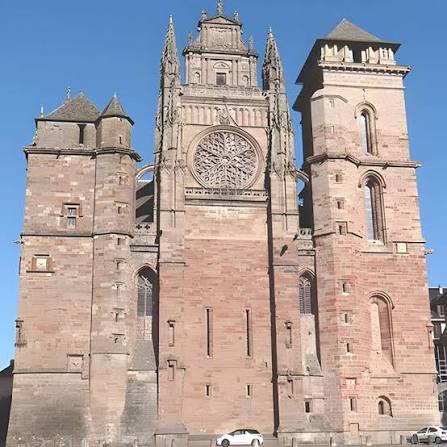


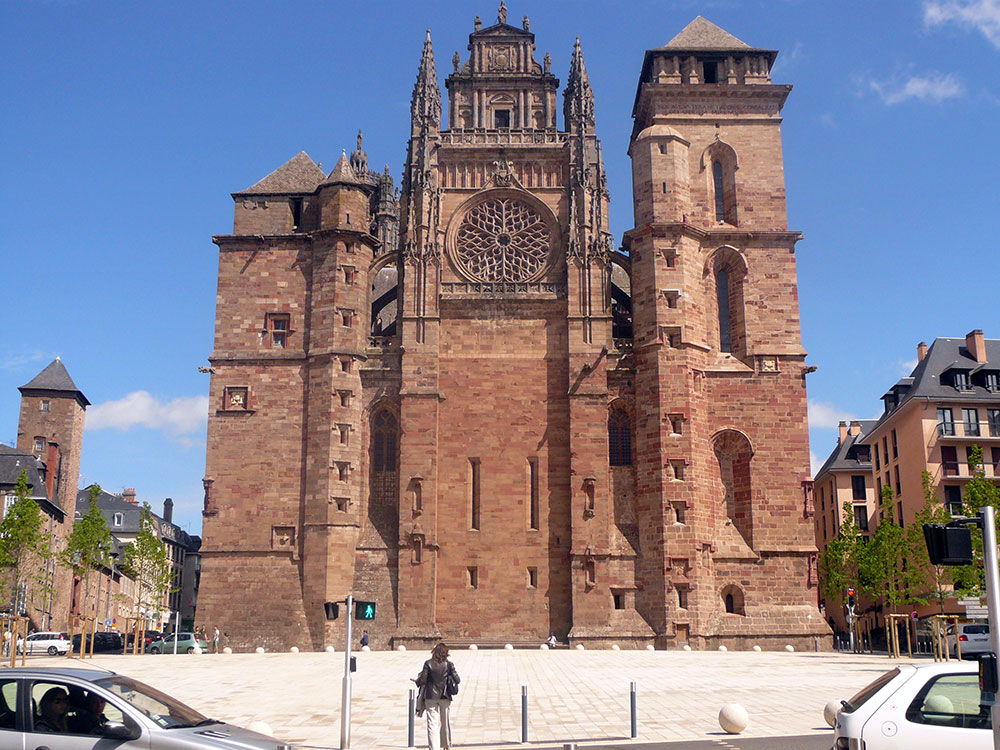
As soon as they arrive in Rodez, tourists and pilgrims are drawn to the cathedral’s bell tower.
A Bit of History...
Construction of the Notre-Dame de Rodez Cathedral began in 1277 and was not completed until the 16th century.
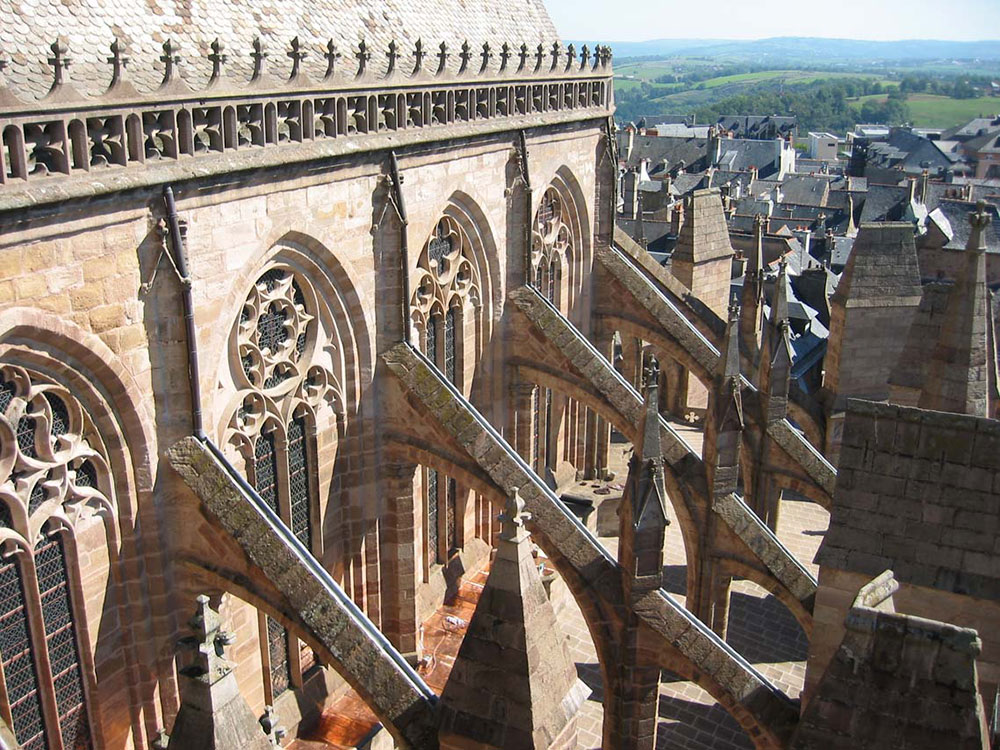
Three centuries of construction went into one of the most imposing Gothic cathedrals in southern France. Built entirely of pink sandstone, the building is distinguished by its fortress-like west facade—which was once part of the city’s ramparts—as well as by its bell tower, designed by the Rouergue architect Antoine Salvanh.
It was erected between 1513 and 1526 at the request of Bishop François d’Estaing, and at 87 meters tall, it still holds the title of France’s tallest flat-topped bell tower.
In 1862, the cathedral was designated a Historic Monument.
What to see...
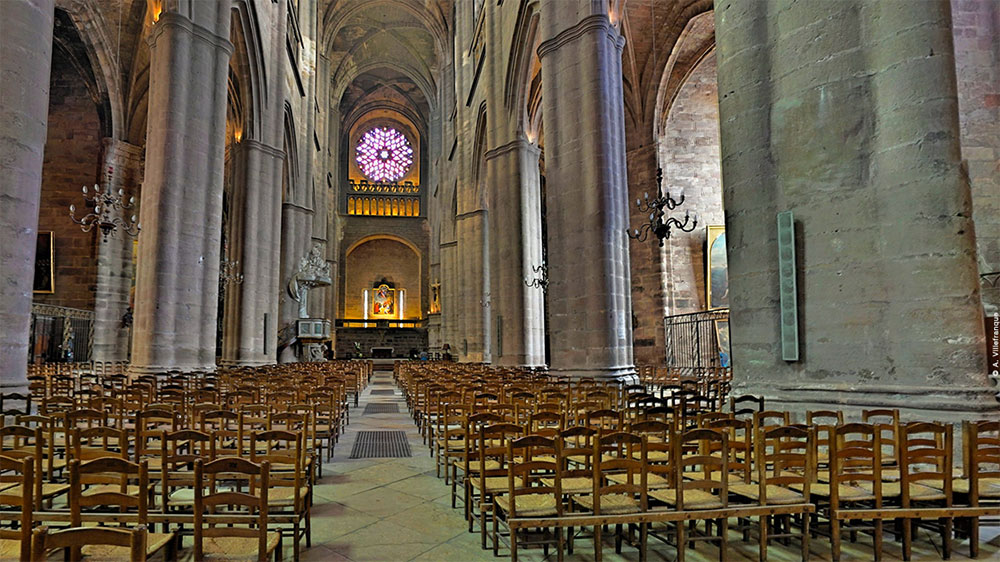
Inside the cathedral, be sure to see:
- the richly decorated choir stalls (15th century), crafted by the workshop of master sculptor André Sulpice,
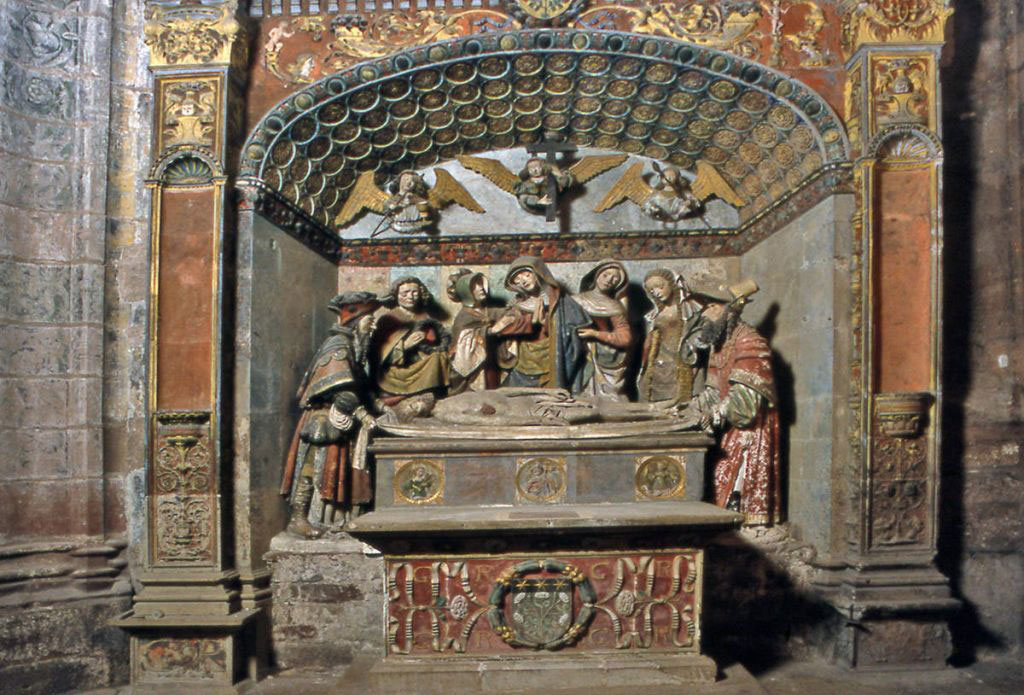
- the monumental altarpiece in the chapel known as the Gaillard Roux Chapel (or Chapel of the Holy Sepulcher) and its sculpted group depicting the Entombment (16th century),
- the Chapel of the Blessed Sacrament (16th century), topped by a gallery and adorned with a coffered vault,
- the grand organ case (17th century),
- the contemporary stained-glass windows by Stéphane Belzère.
Around the cathedral, numerous buildings bear witness to this neighborhood’s rich past:
- the Bishop’s Palace (17th century), recognizable by its brick façade, its grand double staircase, and its fortified terraces, which offer a beautiful view of the bell tower from the palace courtyard,
- the Delauro Mansion (16th century), now the Maison des Compagnons du Devoir de Rodez
- the Canon’s House, former residence of the cathedral’s canons (15th century)
- the House of Benoît (15th century).
In 2002, the French government—through the Regional Office for the Preservation of Historic Monuments—sought to restore stained-glass windows to the cathedral that would be worthy of the building and entrusted the design of these new windows to an artist. Following a call for submissions, Stéphane Belzère’s proposal was selected. This marked the first public commission for the artist, who was born in 1963. The seven stained-glass windows in the central chapels were created between 2002 and 2007 by the artist, in collaboration with the Duchemin studio.
Stéphane Belzère’s stained-glass windows are part of the “Art in Public Spaces in Aveyron” trail.
Finally, another point of interest is the figure supporting the pulpit. According to tradition, it does not symbolize heresy but rather an Atlas, thus reinforcing an ancient local belief that the people of Aveyron are descendants of this mythical people.
Rodez Cathedral by the Numbers:
107 meters long, 36 meters wide (one of the largest Gothic cathedrals in southern France)
30 meters high at the vault (nave and choir)
27 chapels
300 years of construction (from the 13th to the 16th century)
Organ: walnut case over 20 meters tall, 3,155 pipes
Public Access
The two entrance doors to Rodez Cathedral are located on either side of the building:
– Rue Frayssinous (stairs),
– Place Adrien Rozier (stairs and an access ramp for people with limited mobility).
Admission is free and open to the public.
Rodez Cathedral
Rue Frayssinous,
12000 Rodez
Tel.: 05 65 87 12 50
https://www.rodez-tourisme.fr/offres/cathedrale-notre-dame-de-rodez-rodez-fr-281100/