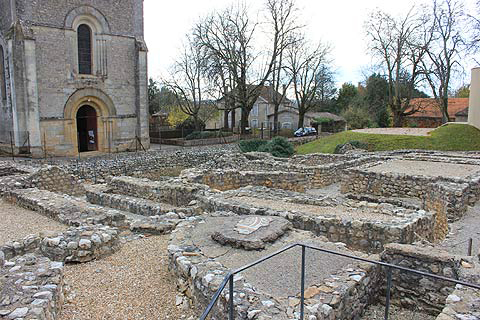


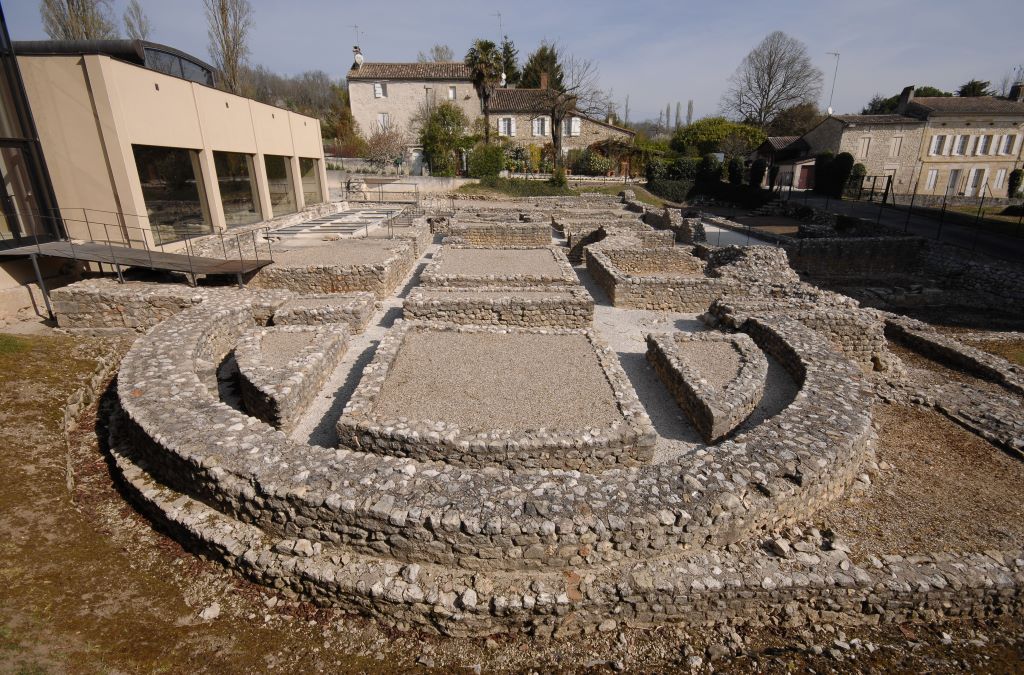
Montcaret, in the Périgord Pourpre in the southwestern part of the Dordogne, located about 40 km west of Bergerac, is best known for the remains of a Roman villa, discovered by workmen during the 19th century.
The archaeological site of Montcaret, its Gallo-Roman villa (rural aristocratic residence) and its private baths with exceptional mosaic pavements are worth a visit.
A grand aristocratic residence, adorned with remarkable mosaic floors, it stands out for both its size and its architectural decoration. Covering a total area estimated at 2,200 m², its ruins feature three elements characteristic of the residences of the Roman Empire’s elite:
- a large ceremonial hall of nearly 330 m², connected to a 60 m² dining room with well-preserved decorations
- a peristyle that surrounded a large interior garden (where the village’s Romanesque church was built in the Middle Ages)
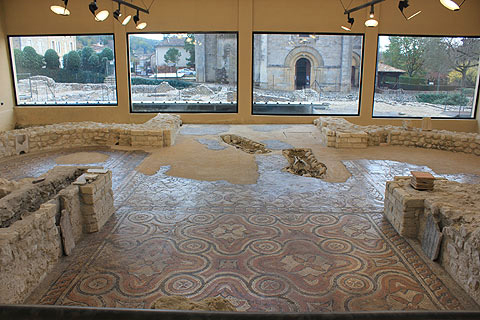
- a large bath wing, where remarkable mosaics are still visible
We can also see various mosaic pavements. The frigidarium, the cold bath, is decorated with a mosaic composed of 16 square panels of which 13 are perfectly preserved. They illustrate the world of the sea (fish and shellfish). The pavements of the other rooms are decorated with geometric and plant motifs.
A small museum containing objects discovered during the archaeological excavations has been opened.
Another site of interest is the 11th century church of Montcaret, built by Benedictine monks using stone from the Roman villa.
To see in particular, inside scenes like "Daniel and lions" and on the outside wall of the church, a sculpture of Adam and Eve.
Around the church, among the excavations of the Gallo-Roman villa, are several sarcophagi.
Another interesting monument is the Pigeonnier de Montvert, on the border of Montcaret on the territory of Saint Seurin de Prats, which dates from the 17th century.
Town hall of Montcaret
24230 Montcaret
Tel : 05 53 58 60 06
http://www.villa-montcaret.fr/
Translated with www.DeepL.com/Translator
(free version)