

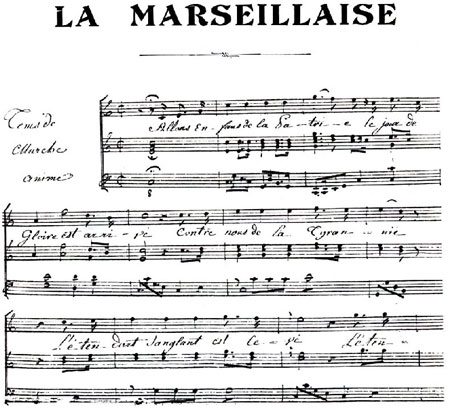
La Marseillaise was written by Claude Joseph Rouget, known as de Lisle, often referred to as Rouget de l'Isle, an engineer captain then stationed in Strasbourg. He composed it on the night of April 25-26, 1792, following the declaration of war on Austria on April 20, 1792.
Initially, it went by various names: “Chant de guerre pour l'armée du Rhin”, “Chant de marche des volontaires de l'armée du Rhin”.
Doctor François Mireur, future general of the armies of Italy and Egypt, who came to Marseille to organize the joint march of the Midi volunteers, those from Montpellier and Marseille, published this song, in Marseille, for the first time, with a new title: “Chant de guerre des armées aux frontières” (“War song for the armies on the borders”).
The Fédérés troops from Marseilles adopted it as their marching song, and sang it as they made their triumphal entry into the Tuileries in Paris on July 30, 1792.
The Parisian crowd, unconcerned by its various names, christened the song “La Marseillaise”.
This title, apart from its simplicity, had the advantage of marking the unity of the Nation from Strasbourg to Marseille, from the East to the South.