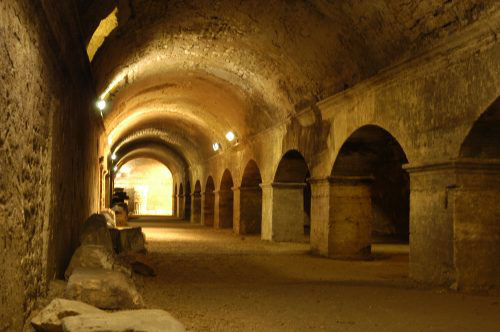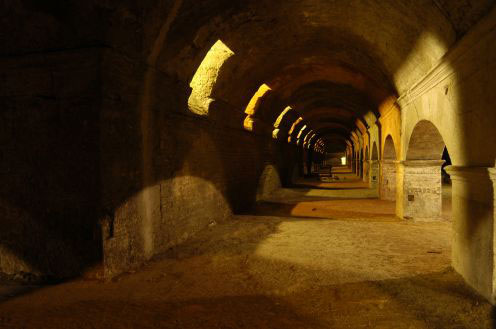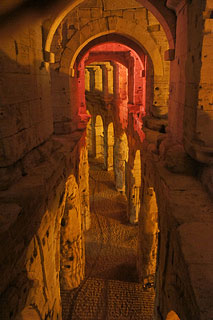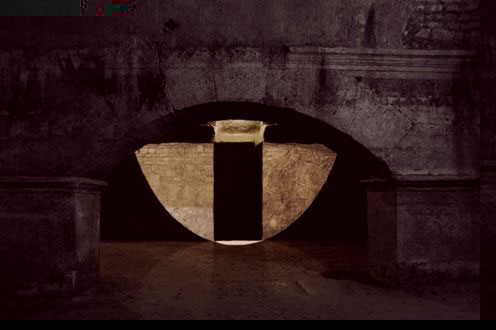



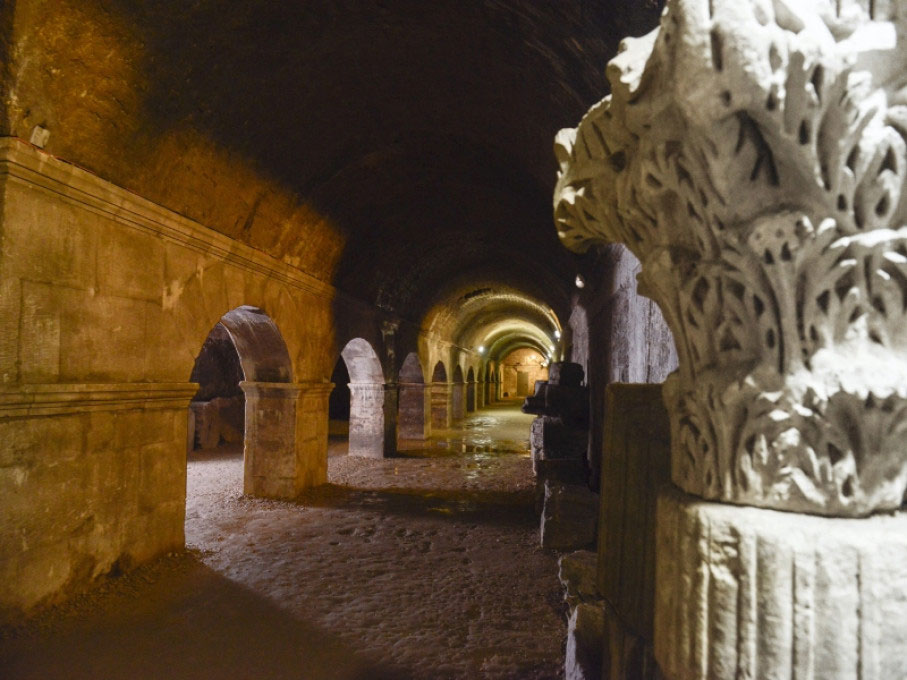
Owned by the city of Arles, the Cryptoporticus forms the foundation—the hidden part—of the Forum, the central public square of the Roman city.
It was intended to support the Forum, one of the first urban projects of the new Roman colony founded in 46 B.C.
“They consist of three galleries forming a U-shape open toward the east. The southern gallery is carved into the rock, while to the north, the ground has been filled in by several meters, which has allowed for the preservation of remains from the pre-Roman city. The current street level corresponds fairly closely to that of the ancient ground level, which was significantly lower than today’s. Only the northern gallery, due to the slope of the terrain, opened onto a square, the predecessor of today’s Place du Forum. A fourth gallery, characterized by the use of bricks, likely attests to a restructuring of the forum in Late Antiquity.
In the early 5th century, the cryptoporticoes were partitioned off to serve as cellars for private individuals. At the end of the south gallery, which lies directly beneath City Hall, one can see the remains of ancient prisons through the air vents.”
A Bit of History
Because of these transformations, the monument’s past remained a mystery for a long time. For a time, it was thought to be a catacomb. During construction of City Hall in the 17th century, questions arose about the building’s Roman origins. In 1737, a fire in the basement of the Church of Saint-Lucien—which had been known since the 10th century—revealed a carved frieze confirming this hypothesis. In 1951, the excavation of the galleries uncovered a marble deposit containing various fragments of statuary and inscriptions, one of which was addressed to Emperor Augustus.
These discoveries provided proof of the true nature of the cryptoporticoes and the significance of the imperial cult associated with the Roman forum.
Access to the cryptoporticoes—which had been looted and divided into lots—was completely closed off in the 10th century with the construction of the Church of Saint-Lucien. The lengthy process of clearing out cellars one by one and excavating the galleries began in 1935, yielding particularly fruitful results in 1951 that allowed for the formal identification of the structure.
In 1966, the galleries were opened to the public, accessible from the Jesuit Chapel on Rue Balze.
Today, a new path provides access from the far end of the south gallery, directly beneath City Hall.
Lighting
In 2018, the first gallery of the Cryptoporticus was illuminated
The complete lighting of the site—spanning 350 meters of galleries—will be made possible thanks to a sponsorship from Gucci, which has pledged 250,000 euros in financial support to the City for the restoration of its heritage sites. A budget of 70,000 euros will be allocated to this lighting project.
The Cryptoportiques are one of six monuments managed by the City: the Amphitheater, the Ancient Theater, the Cryptoportiques, the Baths of Constantine, the Alyscamps site, and the Saint-Trophime Cloister.
They are open daily from 9 a.m. to 7 p.m. during the high season (May through September).
Access to the cryptoporticoes is via the Salle des Pas Perdus in City Hall, Place de la République.
Heritage Department 04 90 49 38 20.
City Hall
Place de la République
13200 Arles
Tel.: 04 90 49 59 05
https://www.arlestourisme.com/fr/d%C3%A9tails.html?=Les+cryptoportiques+du+Forum&ident=5538697